2009 Guidelines for the Treatment of Acne
Publication of THE LATEST IN ACNE CARE supplement was made possible by an unrestricted educational grant from Galderma Canada Inc.
Neil H. Shear, MD, FRCPC, FACP, Professor and Chief of Dermatology, Professor of Medicine, Pediatrics and Pharmacology, University of Toronto Faculty of Medicine; Head of Dermatology, Sunnybrook Health Sciences Centre, Toronto, ON.
Abstract
This article summarizes key statements from the 2009 Global Alliance to Improve Outcomes in Acne Group's therapeutic guidelines, published as a supplement in the Journal of the American Academy of Dermatology (JAAD). It offers an algorithm for acne treatment, as well as addresses important statements from the committee on acne pathophysiology, epidemiology, and the latest research findings, as they pertain to the guidelines.
Keywords: acne, treatment guidelines, adherence, antibiotic resistance, maintenance.
The Global Alliance to Improve Outcomes in Acne Group ("Global Alliance") is an international group of dermatologists with clinical and research expertise in acne vulgaris. The group was formed 10 years ago with arm's-length support from Galderma International. Over 20 dermatologists from North America, Europe, Asia, and Australia have served on this committee. The group has conducted research studies and published widely. Initiating programs to improve consumer and practitioner knowledge has been a priority. As an Alliance member, I have had the opportunity to work on the guidelines and especially contribute to the Group's efforts to define acne as a chronic disease.
The first consensus guidelines were published in 2003 in JAAD and were very well received as an evidence-based and thoughtful document.1 In the 2009 guidelines updated information on pathogenesis, mechanism of action of therapies, and clinical results are presented.2 The update offers new insights into the prevention and management of scarring, and reflects the shift of thinking of acne vulgaris as a chronic disease rather than an acute condition. This approach is helpful in understanding short- and long-term goals and strategies for success. However, such a shift highlights the need for patient education—and the need, in some cases, to educate their physicians. The Alliance holds that dermatologists should be at the forefront in educating other clinicians that acne has characteristics that have traditionally defined chronicity (frequent relapse/recurrence, prolonged course, severe psychosocial impact, etc.).
The Global Alliance has long been committed to reducing the overuse of antimicrobial therapies, especially as single agents. Despite many extensive educational programs this is still a widespread practice and antimicrobial resistance is still on the rise. The 2009 update is quite detailed in this area.
Of course, a key area of interest for members of the Alliance is offering guidelines for dermatologists and other clinicians on choosing the best treatments, early in the course of the disease, with the hope of providing the best long-term outcomes.
Acne Pathophysiology
Acne vulgaris is very common and can be misconstrued as a "rite of passage." But the psychological impact, even of low-severity acne, can be devastating. Treatments are aimed at treating active disease and just as importantly at preventing new disease. Essential to an appropriate understanding of acne as a chronic disease is a clear sense of acne pathophysiology, and the update summarizes the latest research findings (Table 1).
|
|
|
|
|
|
|
| Originally published in Thiboutot D, Gollnick H, Bettoli V, et al. New insights into the management of acne: update from the Global Alliance to improve Outcomes in Acne group. J Am Acad Dermatol 2009;60(5 Suppl):S1-S50. Copyright Elsevier 2009. Reprinted with permission. |
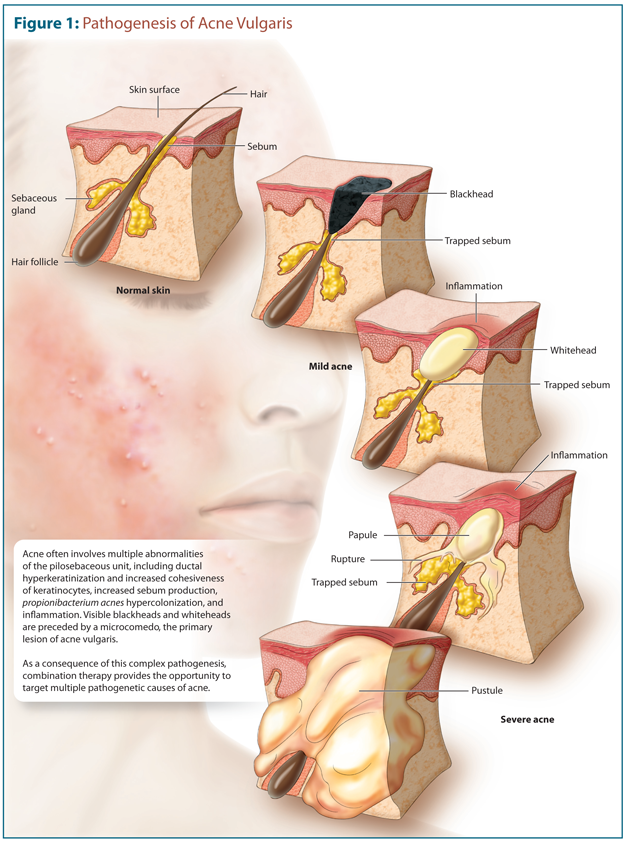
The primary lesion in acne vulgaris is the microcomedo, a "plugged" follicular opening that is only visible microscopically and is the precursor to visible comedones and inflammatory papules (Figure 1). Acne is partially driven by hormonal influences and inflammatory pathways, but most topical treatments target the comedo itself with comedolytic agents. Antimicrobial agents are not comedolytic, but retinoids and benzoyl peroxide are.