Advertisement

Advertisement

Insufficiency Fractures of the Femur and Sacrum

Teaser: 

Dr. M.S. Alam, MD, MBBS, CCFP, FCFP

Clinical Lecturer, Cumming School of Medicine, Calgary, University of Calgary, Family Medicine Department, Calgary, AB.

CLINICAL TOOLS

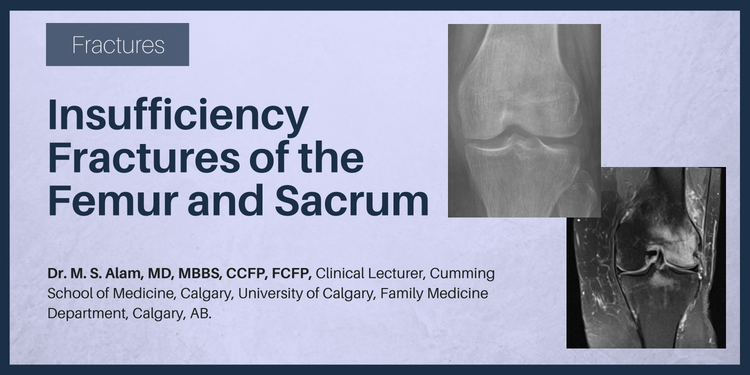
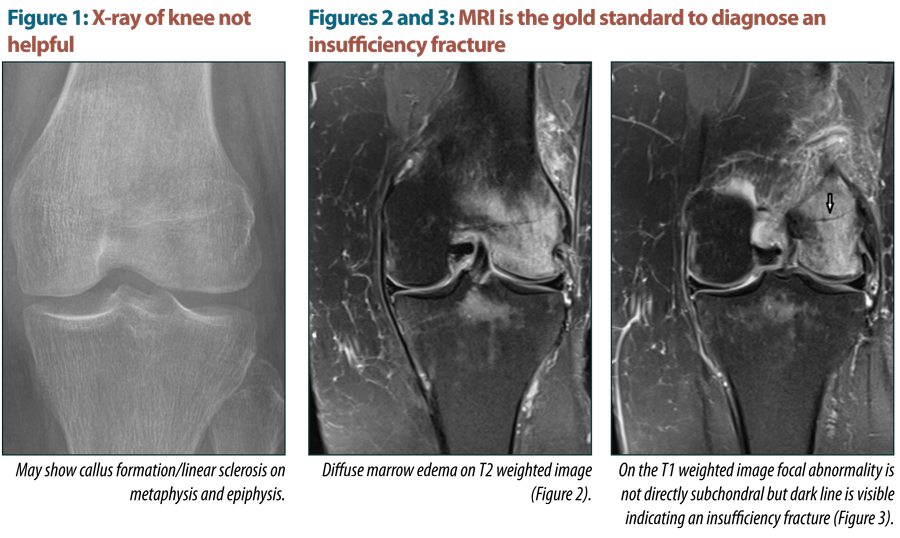
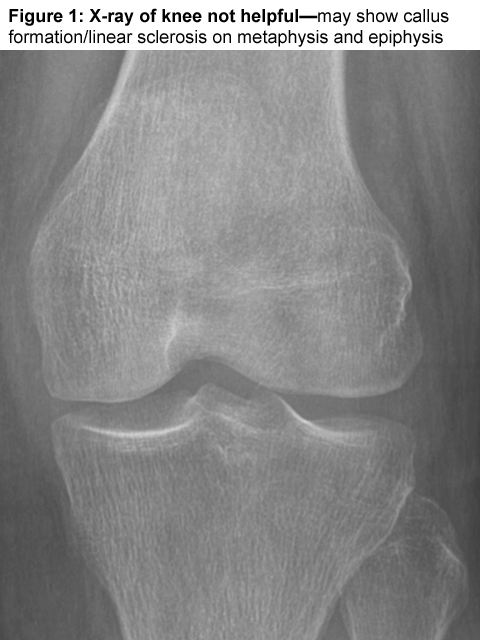
Abstract: Insufficiency Fractures (I.F) are non-traumatic fractures that occur in abnormal bone (low density bone). Usually occurs in elderly post-menopausal women and is non-traumatic. X-rays are unremarkable and MRI showed extensive bone marrow oedema and subchondral fracture.
Ms. Shirley Cooke, a 61 year old with a background of low bone mass, breast cancer, Diabetes Melitis type 2, HTN, splenic artery thrombosis came in with a dull pain on her left knee and occasionally some sharp element, with unremarkable examination on knees.
Recently, she was diagnosed with left ankle avulsion fracture of lateral maleolus and is wearing an ankle boot for healing.
It is important to make the correct diagnosis in order to avoid complications."
Key Words: Insufficiency Fracture (I.F), low bone mass, management.
1. With regard to I.F of femoral Condyle—Although the knee symptoms will always be unilateral, on the side of the meniscal tear, and are more frequent in older woman, the pain of an insufficiency fracture can easily be confused with that of other joint pathologies and therefore be easily missed.2
2. With regard to I.F of Femoral Neck—This fracture is seen in the elderly osteoporotic patient, often following a trivial event such as a slip without a fall. The resultant boney defect may be a compression fracture, which is inherently stable, or a transverse fracture, more common in older patients and is potentially much more serious.
3. With regard to I.F of Sacrum—The possibility of an insufficiency fracture should be considered in elderly osteoporotic patients, particularly women, following evenly seeming innocuous trauma to the posterior pelvis who exhibit constant buttock pain which may radiate to the thigh or groin and is unaffected by spinal movement.
MRI is the gold standard for Dx. I.F.
Symptoms and conventional tests may not be helpful, High Index of suspicious is needed.
To have access to full article that these tools were developed for, please subscribe. The cost to subscribe is $80 USD per year and you will gain full access to all the premium content on www.healthplexus.net, an educational portal, that hosts 1000s of clinical reviews, case studies, educational visual aids and more as well as within the mobile app.
Disclaimer: 
Disclaimer at the end of each page

JCCC 2018 Issue 2

Table of Contents

JCCC 2018 Issue 1

Table of Contents

JCCC 2018 Issue 1

Table of Contents

The Canadian Spine Surgeon’s Perspective: Avoiding Opioid Use in Spine Patients

Teaser: 

Alexandra Stratton, MD, MSc, FRCSC,1
Dr. Darren Roffey, PhD,2
Dr. Erica Stone, MD, FRCPC,3
Mohamed M. El Koussy, BSc,4
Dr. Eugene Wai, MD,5

1Orthopaedic Spinal Surgeon, University of Ottawa Combined Adult Spinal Surgery Program, Division of Orthopaedic Surgery, The Ottawa Hospital, Ottawa, ON.
2University of Ottawa Spine Program, The Ottawa Hospital, Ottawa, ON, Clinical Epidemiology Program, Ottawa Hospital Research Institute, Ottawa, ON.
3Anesthesiology, PGY 6 Pain Medicine, The Ottawa Hospital, Ottawa, ON.
4Clinical Research Assistant, University of Ottawa Combined Adult Spinal Surgery Program, Division of Orthopaedic Surgery, The Ottawa Hospital, Ottawa, ON.
5is an orthopedic surgeon who specializes in the care of adult spinal disorders. He is also an Associate Professor in the Department of Surgery at the University of Ottawa. In addition he is the Research Chair for the Canadian Spine Society. Department of Orthopaedic Surgery, Centre Hospitalier Universitaire de Québec, Laval University, QC.


CLINICAL TOOLS

Abstract: Opioids are drugs with pain relieving properties; however, there is evidence that opioids are no more effective than non-opioid medications in treating low back pain (LBP), and opioid use results in higher adverse events and worse surgical outcomes. First line treatment should emphasize non-pharmacological modalities including education, self-care strategies, and physical rehabilitation. Non-steroidal anti-inflammatory drugs (NSAIDs) are generally considered an appropriate introduction into pharmacological treatment when deemed necessary. Non-opioid adjunct medications can be considered for specific features related to LBP such as neuropathic leg pain. Primary care providers should exhaust first and second line treatments before considering low-dose opioids, and only then in consultation with evidence-based clinical practice guidelines.
Key Words: Pharmacological; low back pain; radiculopathy; opioids; analgesia.

Members of the College of Family Physicians of Canada may claim MAINPRO-M2 Credits for this unaccredited educational program.

www.cfpc.ca/Mainpro_M2

You can take quizzes without subscribing; however, your results will not be stored. Subscribers will have access to their quiz results for future reference.

1. First line treatment for low back and radicular leg pain is non-pharmacological.
2. Second line treatment includes NSAIDs (with or without proton pump inhibitor), and muscle relaxants (3 weeks maximum), gabapentinoids and antidepressants.
3. Exhausting non-opioid analgesics includes trialing different medications within the same class and at different doses since many of these medications have wide therapeutic dose ranges.
A "start low and go slow" approach is recommended for initiating pharmacological treatments for low back and radicular leg pain, especially when using neuroleptics and antidepressants.
When treating low back pain with neuropathic leg pain, patients who fail a trial of pregabalin may tolerate gabapentin, or vice versa.
Antidepressants have a role in managing low back pain, particularly chronic, even in the absence of mood disorder.
To have access to full article that these tools were developed for, please subscribe. The cost to subscribe is $80 USD per year and you will gain full access to all the premium content on www.healthplexus.net, an educational portal, that hosts 1000s of clinical reviews, case studies, educational visual aids and more as well as within the mobile app.
Disclaimer: 
Disclaimer at the end of each page