Neurostimulation médullaire : une approche thérapeutique de la douleur sous-utilisée et mal reconnue

Points clés / Informations cliniques importantes

Les indications thérapeutiques les plus étudiées de la SM sont la douleur neuropathique postopératoire persistante (également connue sous le nom de « séquelles de l'échec chirurgical rachidien ») et le syndrome douloureux régional complexe (SDRC).
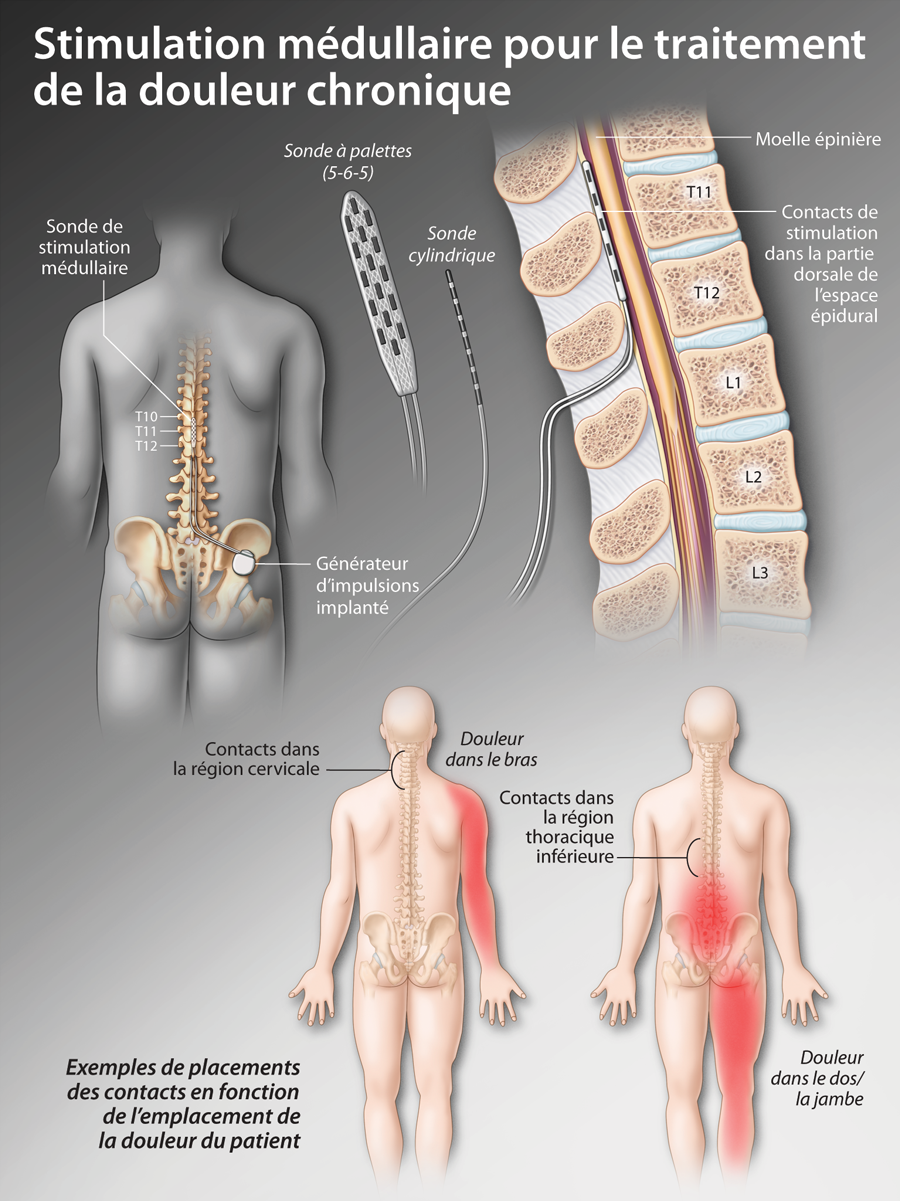
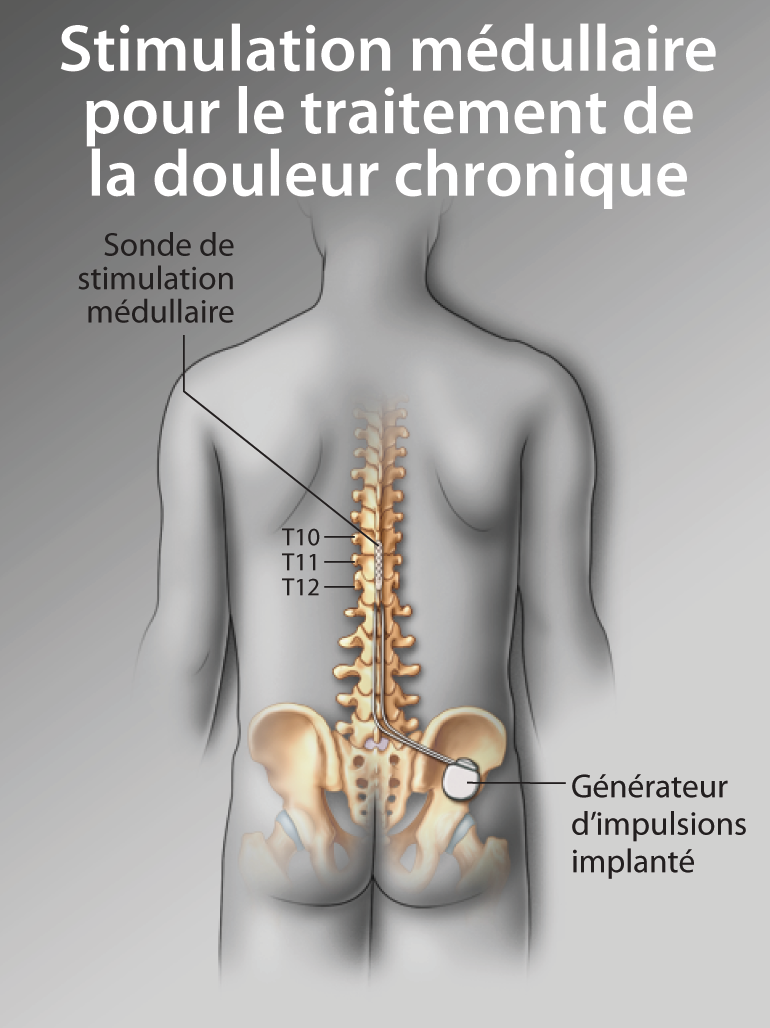
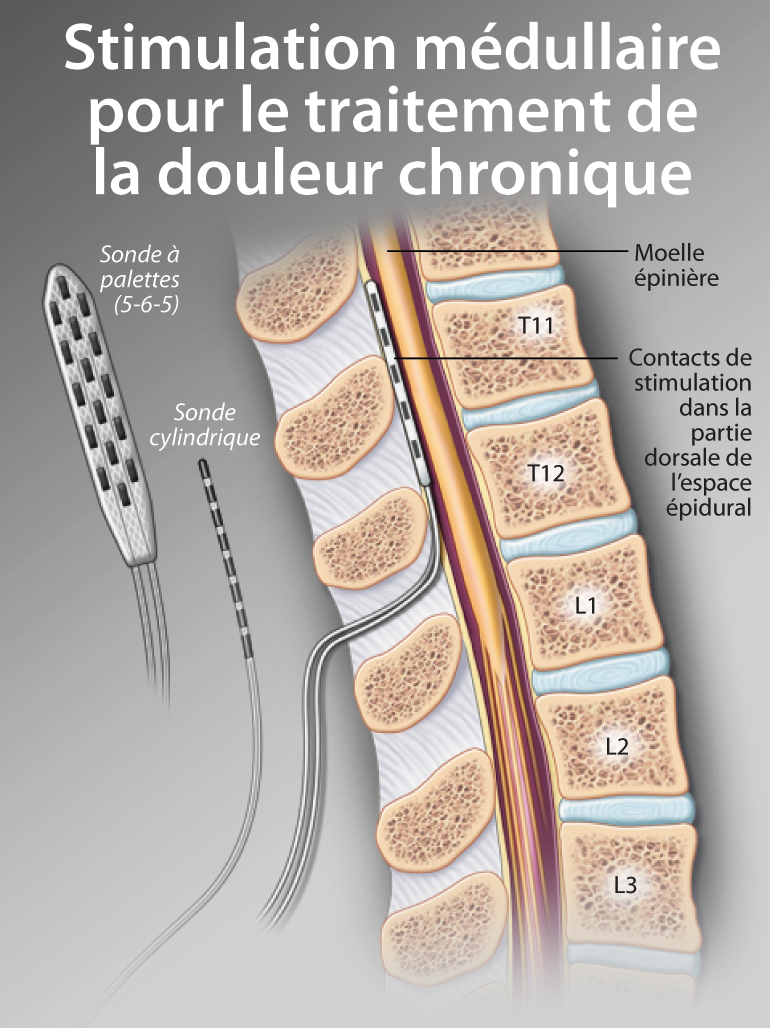
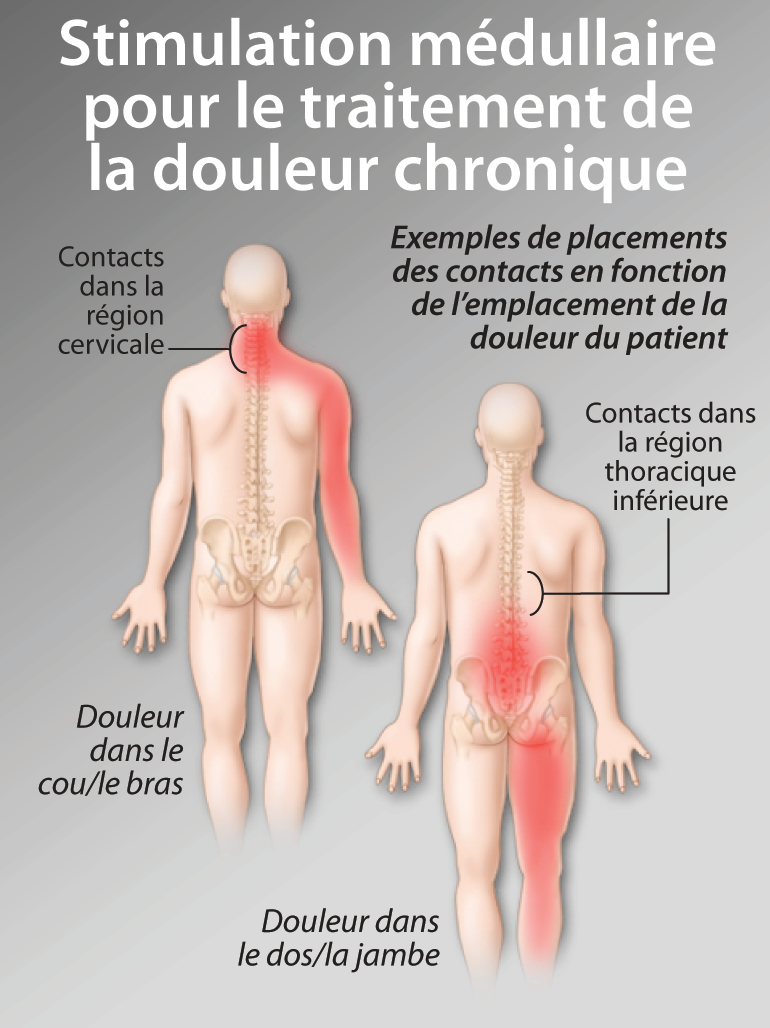
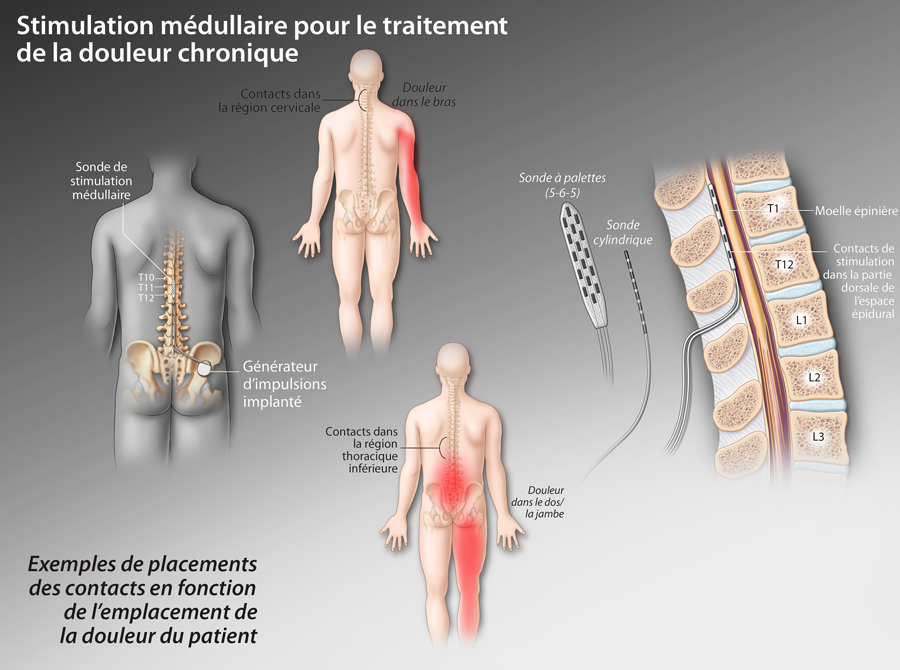
La clé du succès de la SM consiste à établir un profil de paresthésie qui englobe la zone douloureuse du patient, tout en évitant toute paresthésie supplémentaire qui pourrait entraîner une gêne.
La SM est un traitement économique, car les économies réalisées sur le long terme dans divers domaines (imagerie diagnostique, consultations médicales, médicaments et services de rééducation) dépassent les coûts initiaux plus élevés.
Les contre-indications à la pose d'un dispositif de SM sont les suivantes : infection généralisée, trouble cognitif et faible taux de plaquettes.
Les facteurs suivants sont reconnus comme étant prédictifs du succès à long terme de la SM : douleur ayant surtout une composante neuropathique périphérique, traitement entrepris tôt au cours de l'évolution du syndrome douloureux et présence d'une allodynie ou d'autres caractéristiques indicatrices d'une douleur neuropathique. Une humeur profondément dépressive, un manque d'énergie, une somatisation et un manque d'adaptation psychologique sont des facteurs importants prédisant de mauvais résultats thérapeutiques.
La SM est une technique non destructive : le dispositif peut se retirer à tout moment s'il ne permet plus de soulager la douleur et il n'empêche pas d'avoir ultérieurement recours à d'autres approches thérapeutiques, y compris la chirurgie rachidienne.
 

Bibliographie

  1. Schopflocher D, Taenzer P, and Jovey R. The prevalence of chronic pain in Canada. Pain Res Manag 2011; 16: 445-450.
  2. Reitsma ML, Tranmer JE, Buchanan DM, Vandenkerkhof EG. The prevalence of chronic pain and pain-related interference in the Canadian population from 1994 to 2008. Chron Dis Inj Can 2011; 31: 157-164.
  3. Peng P, Choinere M, Dion D, Intrater H, Lefort S, Lynch M, Ong M, Rashiq S, Tkachuck G, Veillette Y. Challenges in accessing multidisciplinary pain treatment facilities in Canada. Can J Anesth 2007; 54: 977-984.
  4. The Painful Truth Survey Report (2014 Oct 17). Retrieved from http://www.canadianpaincoalition.ca/index.php/en/about-us/media-room/2014/10/17/242
  5. Benjamin R, Trescot AM, Datta S, et al. Opioid complications and side effects. Pain Physician 2008; 11(2 Suppl): S105-20.
  6. Joint Statement of Action to Address the Opioid Crisis (2017 Nov 19). Retrieved from https://www.canada.ca/en/health-canada/services/substance-abuse/opioid-conference/joint-statement-action-address-opioid-crisis.html?_ga=1.151650431.732537752.1490933782
  7. Fischer B and Argento E. Prescription opioid related misuse, harms, diversion and interventions in Canada: A Review. Pain Physician 2012; 15: ES191-203.
  8. International Narcotics Control Board. (2013). Narcotics Drugs: Estimated World Requirements for 2013; Statistics for 2011. New York: 
United Nation
  9. Nasser R, Yadla S, Maltenfort G, Harrop JS, Anderson DG et al. Complications in spine surgery. J Neurosurg Spine 2010; 13: 144-157.
  10. Deer TR, Mekhail N, Provenzano D, Pope J et al. The appropriate use of neurostimulation of the spinal cord and peripheral nervous system for the treatment of chronic pain and ischemic diseases: The Neuromodulation Appropriateness Consensus Committee (NACC). Neuromodulation 2014; 17: 515-550.
  11. Gildenberg PL. History of electrical neuromodulation for chronic pain. Pain Med 2006; 7: S7-13.
  12. Linderoth B. Spinal cord stimulation: a brief update on mechanisms of action. Eur J Pain Supp 2009; 89–93.
  13. Deer TR, Mehkail N, Prvenzano D, Pope J et al. The appropriate use of neurostimulation: avoidance and treatment of complications of neurostimulation therapies for the treatment of chronic pain. Neuromodulation 2014; 17: 571-597.
  14. Kumar K, Toth C, Nath R, Laing P. Epidural spinal cord stimulation for treatment of chronic pain-some predictors of success. A 15-year experience. Surg Neurol 1998; 50: 110–121.
  15. Kumar K, Hunter G, Demeria D. Spinal cord stimulation in treatment of chronic benign pain: challenges in treatment planning and present status, a 22-year experience. Neurosurgery 2006; 58: 481–496.
  16. Williams KA, Gonzalez-Fernandez M, Hamzehzadeh S, Wilkinson I et al. A multi-center analysis evaluating factors associated with spinal cord stimulation outcome in chronic pain patients. Pain Med 2011; 12: 1142-1153.
  17. Baron R, Backonja MM, Eldridge P, Levy R et al. Refractory Chronic Pain Screening Tool (RCPST): A Feasibility Study to Assess Practicality and Validity of Identifying Potential Neurostimulation Candidates. Pain Med 2014;15:281-291.
  18. Olson KA, Bedder MD, Anderson VC, Burchiel KJ, Villanueva MR. Psychological variables associated with outcome of spinal cord stimulation trials. Neuromodulation 1998; 1: 6–13.
  19. Celestin J, Edwards RR, Jamison RN. Pretreatment psychosocial variables as predictors of outcomes following lumbar surgery and spinal cord stimulation: a systematic review and literature synthesis. Pain Med 2009; 10: 639–653.
  20. Trief P et al. A prospective study of psychological predictors of lumbar spine surgery outcome. Spine 2000; 25: 2616-2621.
  21. Ghoneim MM and O'Hara MW. Depression and postoperative complications: an overview. BMC Surgery 2016; 5.
  22. Stephens KA and Ward A. Patient selection for spinal cord stimulators: mental health perspective. Curr Pain Headache Rep 2014; 18: 398.
  23. Deer TR, Narouze S, Provenzano DA, Pope J et al. The Neurostimulation Appropriateness Consensus Committee (NACC): Recommendations on Bleeding and Coagulation Management in Neurostimulation Devices. Neuromodulation 2017; 20: 51-62.
  24. North RB. SCS trial duration. Neuromodulation 2003; 6: 4–5.
  25. Kumar K and Rizvi, S. Cost-Effectiveness of Spinal Cord Stimulation Therapy in Management of Chronic Pain. Pain Med 2013; 14: 1631-1649.
  26. Kumar K, Taylor RS, Jacques, L, Eldabe S et al. Spinal cord stimulation versus conventional medical management for neuropathic pain: a multicentre randomised controlled trial in patients with failed back surgery. Pain 2007; 132: 179-188.
Disclaimer: 
Cet article a été publié dans le cadre de Prise en charge de la santé de votre patient âgé : thérapies qui pourraient aider à améliorer la qualité de vie ressource FMC. Ce document a reçu un appui dans le cadre d’une subvention pédagogique de Medtronic Canada Ltée.