Members of the College of Family Physicians of Canada may claim one non-certified credit per hour for this non-certified educational program.
Mainpro+® Overview
Sean Christie, MD, MSc, FRCSC, Associate Professor, Department of Surgery (Neurosurgery), Department of Medical Neurosciences, Dalhousie University, Halifax, Nova Scotia.
Aaron S. Robichaud, MD, Clinical Fellow, Department of Surgery (Neurosurgery), Department of Medical Neurosciences, Dalhousie University, Halifax, Nova Scotia.

ABSTRACT
Cervical myelopathy is a degenerative disease that occurs secondary to direct spinal cord compression and compromise of spinal vasculature through a process of gradual spinal canal narrowing. Patients generally present with signs and symptoms of long tract compromise. Once myelopathy is suspected on clinical grounds, MRI is the test of choice to confirm canal stenosis and cord injury. Treatment involves surgical decompression, anteriorly and/or posteriorly of the spinal. Despite optimal management in this patient population, outcomes may be poor and are usually limited to halting progression of the disease rather than relieving deficits already present.
KEYWORDS: Cervical myelopathy, cervical stenosis, degenerative spine disease, spondylosis.
Introduction
Myelopathy is a term used to describe the clinical syndrome present when a disease process in or around the spinal cord interrupts the normal transmission of information along the ascending and descending tracts contained within it. The syndrome can be differentiated based on the level of pathologic involvement, which can generally be determined by the extent of involvement of the extremities as documented on physical examination. Cervical myelopathy occurs when the disease process affects the cervical spinal cord, and can manifest as symptoms in all four extremities. As implied in the definition, a number of pathological processes can give rise to this clinical syndrome, but the most common cause is canal stenosis secondary to degenerative changes commonly seen with aging, termed 'cervical spondylotic myelopathy'.1
Pathophysiology
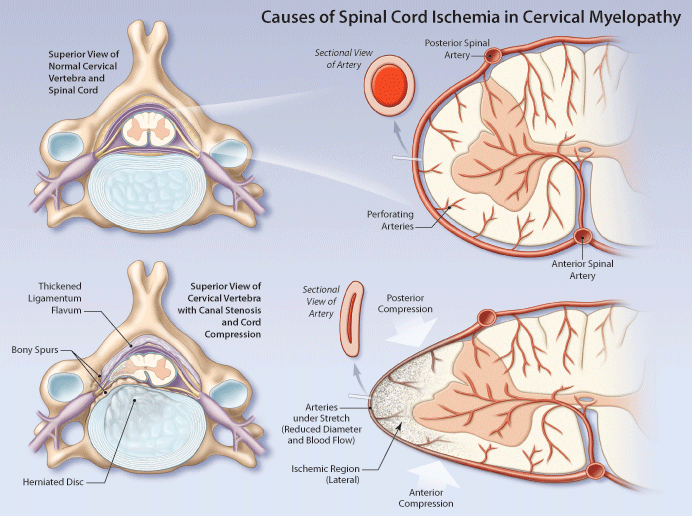
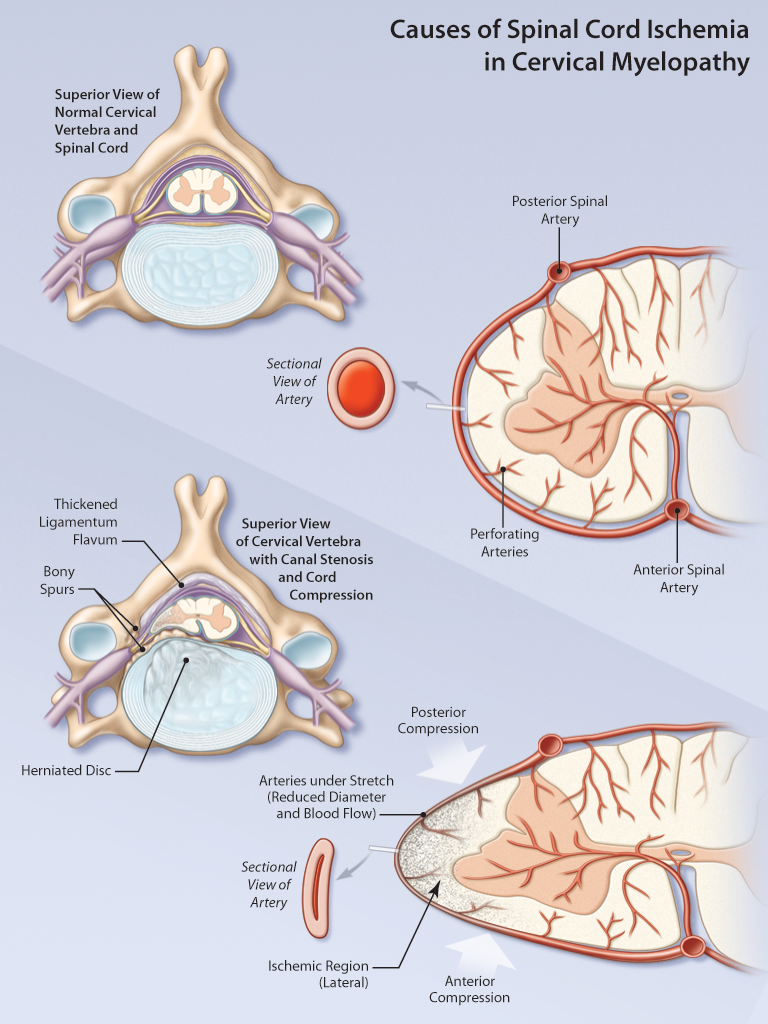
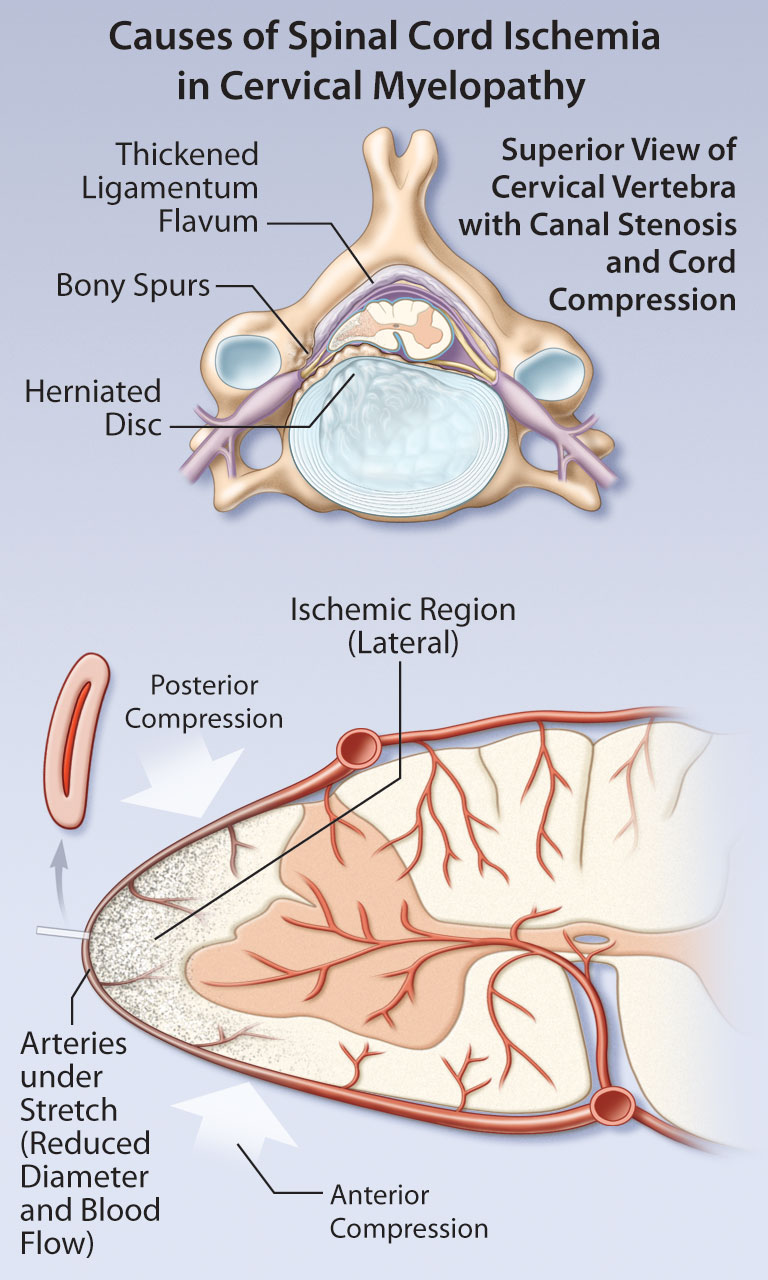
Cervical spondylotic myelopathy (CSM) is a syndrome of spinal cord dysfunction secondary to spinal cord compression, resulting from spinal canal narrowing via both static and dynamic mechanisms, with the underlying cause being slow mechanical degeneration. The normal anterior-posterior (AP) canal diameter in the cervical spine has been reported as 17 to 18 mm.2 However, in patients with CSM, the AP diameter decreases, and signs of myelopathy begin to show when the diameter is decreased to 14 mm or less.3 The average diameter at which myelopathy occurs is 12 mm,4 and this has been accepted as the absolute diameter below which myelopathy is very likely to be present. These studies, based on measurement from plain x-rays, noted that myelopathic findings are present across a range of canal diameters, and this is highly individual, leading to the argument that cord compression alone does not generate myelopathy. Subsequently, cadaver studies have demonstrated arterial filling defects in spinal arteries with neck motion,5 thus leading to the hypothesis that cord ischemia, as opposed to direct compression, is the primary mechanism by which cord damage occurs.4 Ischemia may result from occlusion of the penetrating arteries to the spinal cord by direct compression, or from narrowing of arteries due to distortion from spinal cord displacement. As the spine becomes flattened by anterior or posterior compression, the cord bulges out laterally, which places the vessels running laterally on the cord under stretch, thus reducing their diameter and limiting the flow of blood to the lateral columns of the cord.6 It is for this reason that myelopathy typically presents with deficits in the lateral aspect of the cord, with anterior and posterior functions spared until late in the disease process, as outlined below.