Advertisement

Advertisement

D'Arcy Little MD CCFP FCFP FRCPC,

D’Arcy Little, MD, CCFP, FCFP, FRCPC, Medical Director, Journal of Current Clinical Care and www.healthplexus.net Radiologist, Orillia Soldiers’ Memorial Hospital, Assistant Professor, Department of Medical Imaging cross-appointed to Department of Family and Community Medicine, University of Toronto, University of Toronto, Toronto, ON.

CLINICAL TOOLS

Abstract:
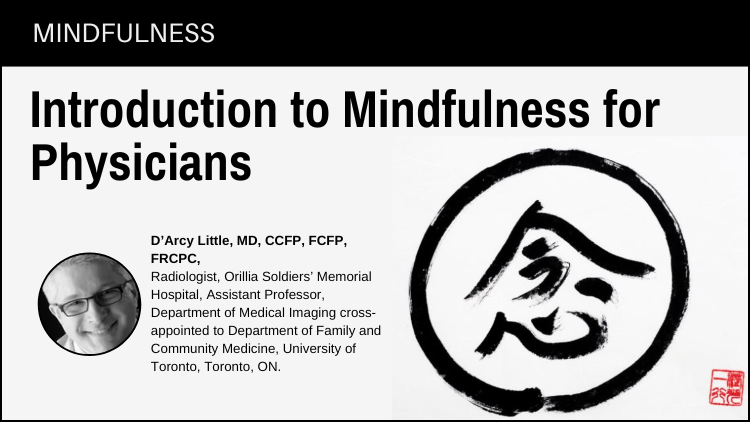
This article was modelled after the Mindfulness Research Symposium and Retreat at the University of Toronto* in partnership with monastics from Plum Village, France, January 2026, the monastery of the famous Vietnamese Buddhist monk, Thich Nhat Hanh. (See Figure 1)
Mindfulness, the practice of bringing non-judgmental awareness to the present moment, has emerged as a significant intervention for addressing physician burnout, enhancing clinical decision-making, and improving patient-provider relationships. This article synthesizes teachings from contemplative traditions with contemporary neuroscience to provide physicians with practical, evidence-informed techniques for cultivating present-moment awareness. Drawing on symposium presentations by experienced practitioners, we explore the foundational elements of mindfulness practice, including breath awareness, body scanning, emotional regulation, and the integration of mindful awareness into daily clinical activities. The article emphasizes that mindfulness is not an additional task to be accomplished but rather a quality of attention that can transform routine activities into opportunities for restoration and insight. *https://www.newcollege.utoronto.ca/events/mindfulness-research-symposium/


Key Words: mindfulness, present-moment awareness, physician burnout, decision-making.
1. Mindfulness is non-judgmental awareness of present-moment experience, distinct from relaxation or concentration techniques.
2. The breath serves as an ideal anchor for practice because it is always available, reflects emotional state, and can be attended to discretely.
3. Difficult emotions, when met with acceptance rather than resistance, tend to resolve within 90 seconds; rumination extends suffering.
4. Integration into clinical workflow requires no additional time; it transforms the quality of attention brought to existing activities.
5. Self-compassion is not self-indulgence; it is a prerequisite for sustainable compassionate care of others.
The 90-Second Emotion Rule: Difficult emotions like anger naturally resolve within 90 seconds if you don’t resist them. Suffering extends beyond this only through rumination. Allow the emotion, then consciously choose whether to continue engaging with it.
Transform Transitions into Micro-Resets: Use existing clinical moments—handwashing, walking between rooms, waiting for the EMR—for brief breath awareness. Even a single conscious breath during these transitions helps reset your presence.
Self-Compassion as Professional Responsibility: Self-care isn’t optional; it’s essential for sustainable patient care. When your inner critic says “I’m not good enough,” recognize this as a passing thought, not truth—it’s one aspect of your experience, not your totality.
To have access to full article that these tools were developed for, please subscribe. The cost to subscribe is $80 USD per year and you will gain full access to all the premium content on www.healthplexus.net, an educational portal, that hosts 1000s of clinical reviews, case studies, educational visual aids and more as well as within the mobile app.
Disclaimer: 
Disclaimer at the end of each page